
Practice Area — Product Liability
Automotive Defect Claims
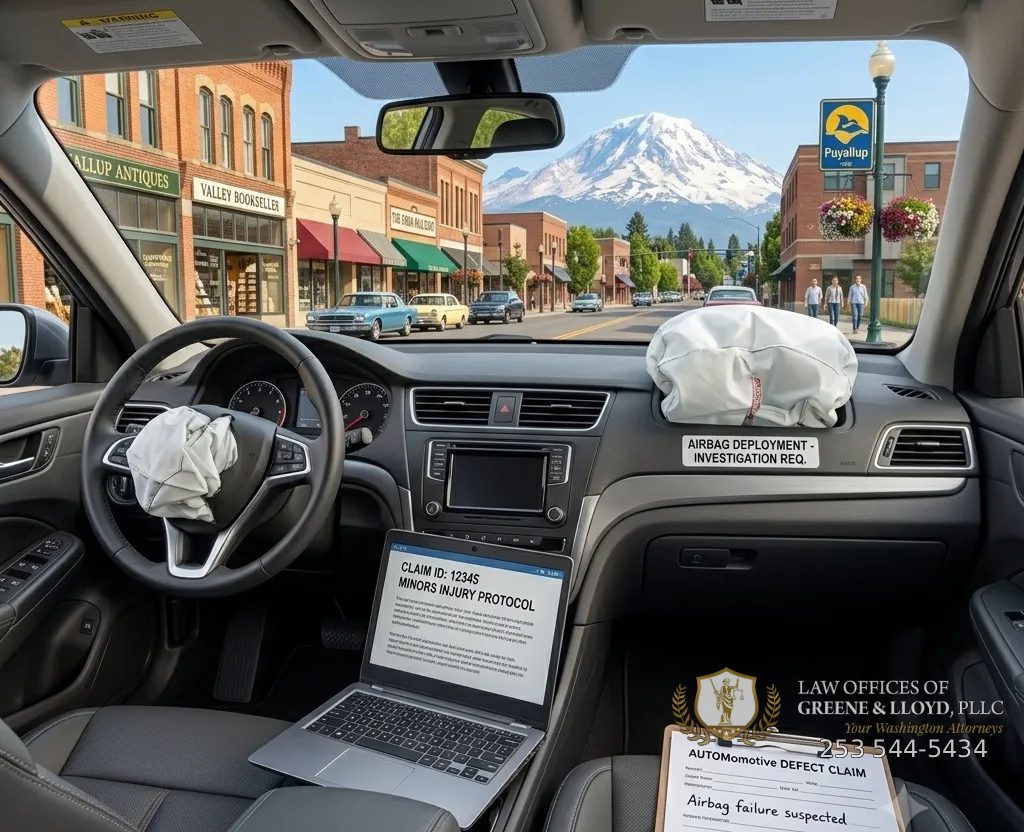
When a defective vehicle part causes a crash or makes injuries worse, Greene & Lloyd holds the manufacturer accountable. Faulty brakes, airbags, tires, and other components injure people every year in Pierce County. If a defect played a role in your injury, Puyallup attorneys Rob Lloyd and Tim Greene can help you pursue the compensation you're owed. Your case review is free and confidential.
Serving Puyallup, South Hill & all of Pierce County · Free consultation available 24/7
3 yrsTo file in WashingtonRCW 4.16.080
No feeUnless we recover for youContingency representation
24/7Free, confidential consultationPuyallup & Pierce County
The BasicsWhat Is an Automotive Defect Claim?
An automotive defect claim is a product liability claim brought when a defective vehicle or vehicle part causes or worsens a crash and injuries. Instead of pursuing only the driver involved, this kind of claim holds the manufacturer responsible for putting a dangerous product on the road. Under Washington's Product Liability Act (RCW 7.72), a manufacturer can be liable when a vehicle or component is unreasonably dangerous in one of three ways:
- Design defect — the part was dangerous as designed, even if built correctly.
- Manufacturing defect — a flaw introduced during production made an otherwise sound design dangerous.
- Failure to warn — the manufacturer didn't provide adequate warnings or instructions about a known risk.
This is different from a "lemon law" complaint about a car that simply keeps breaking down. An automotive defect injury claim is about a defect that hurt someone — and the goal is compensation for that harm.
Common DefectsVehicle Defects That Cause Injuries
Some of the defects most often behind serious injuries include:
- Airbag failures — airbags that fail to deploy, deploy too late, or deploy with dangerous force.
- Defective brakes — brake systems that fail or perform inconsistently.
- Tire failures — tread separation and blowouts that cause loss of control.
- Seatbelt and restraint failures — belts that unlatch or fail to restrain in a crash.
- Steering and suspension defects that lead to loss of control.
- Fuel-system and fire risks, and defects that cause sudden unintended acceleration.
- Poor crashworthiness — roof crush, weak structures, or rollover risks that turn a survivable crash into a catastrophic one.
These crashes often happen on the same busy routes as any collision — corridors like Meridian Ave and Hwy 512 — but the cause traces back to the vehicle itself, not just the drivers involved.
Who's ResponsibleMore Than One Party May Be Liable
Defect claims frequently involve several potentially responsible parties: the vehicle manufacturer, a component or parts maker, a tire manufacturer, or a dealer or repair shop that installed a defective part. Often a defect claim exists alongside a claim against an at-fault driver.
When a defect makes injuries worse
Sometimes another driver causes the crash, but a defect — an airbag that doesn't deploy, a seatbelt that fails, a roof that collapses — makes the injuries far worse than they should have been. Washington law recognizes these crashworthiness or enhanced-injury claims, which can hold a manufacturer responsible for the added harm even when it didn't cause the collision itself.
Washington LawThe Law Behind Your Claim
Washington's Product Liability Act
Under RCW 7.72, a manufacturer can be held liable when a product is unreasonably dangerous because of its design, its manufacture, or a failure to warn — and that defect causes injury. You do not have to prove the manufacturer intended any harm.
Deadline & comparative fault
You generally have three years from the date of injury to file (RCW 4.16.080). And under Washington's pure comparative fault rule (RCW 4.22.005), you can still recover even if you were partly at fault — your recovery is reduced by your share, not eliminated.
This page provides general information about Washington law and is not legal advice. The rules and deadlines that apply depend on the specific facts of your case; contact us to discuss your situation.
Why It's DifferentWhy Defect Claims Need an Experienced Attorney
Automotive defect cases are among the most demanding in personal injury law. They're fought against well-funded manufacturers, and they turn on technical proof that a product was defective — which usually requires preserving the vehicle and the failed part, pulling the vehicle's event data recorder ("black box"), reviewing recall and technical service bulletin history, and working with engineering experts. The single biggest mistake is repairing, scrapping, or letting the insurer take the vehicle before that evidence is preserved.
Greene & Lloyd handles these claims on a contingency-fee basis — no attorney fee upfront, and a fee only if we recover for you. From your first free consultation through resolution, you work directly with attorneys Rob Lloyd and Tim Greene.
Is your issue a "lemon" instead?
If your vehicle is defective but no one was injured — a car that repeatedly breaks down or won't stay fixed — that's typically a consumer or warranty matter ("lemon law"), which follows a different process than an injury claim. Our focus is on defects that cause injury, but if yours is a lemon-law situation, reach out and we can point you toward the right resource.
Common Questions
Automotive Defect Claim FAQ
What qualifies as an automotive defect claim in Puyallup, Washington?
An automotive defect claim is a product liability claim brought when a defective vehicle or vehicle part causes or worsens a crash and injuries. Under Washington's Product Liability Act (RCW 7.72), a manufacturer can be held responsible when a design flaw, manufacturing flaw, or inadequate warning makes a vehicle unreasonably dangerous.
What's the difference between a recall and a defect injury claim?
A recall is a manufacturer or federal notice to repair a known problem — it does not, by itself, compensate you for an injury. A defect injury claim seeks compensation for harm the defect caused. A recall or technical service bulletin can be valuable evidence in that claim.
My car is a "lemon" but no one was hurt — can you help?
A vehicle that keeps breaking down without causing injury is usually a consumer or warranty matter (lemon law), which follows a different process. Our focus is on defects that cause injury. If your situation is a lemon-law matter, we can point you toward the right resource.
What if a defect made my injuries worse but didn't cause the crash?
You may still have a claim. When a defect — such as an airbag that fails to deploy or a seatbelt that fails — makes injuries worse than they should have been, a crashworthiness or enhanced-injury claim can hold the manufacturer responsible for that added harm, even if another driver caused the crash.
How long do I have to file an automotive defect claim?
In Washington, you generally have three years from the date of injury to file (RCW 4.16.080), though exceptions exist. Because defect cases require preserving the vehicle and evidence, it's best to speak with an attorney promptly.
How are automotive defect claims typically paid for?
On a contingency-fee basis. You pay no upfront attorney fee, and a fee is owed only if we recover compensation for you. Your initial consultation is free.
Talk to a Puyallup Automotive Defect Attorney
Hurt by a defective vehicle? Let's find out who's responsible.
If a faulty part caused or worsened your crash injuries, Greene & Lloyd is ready to help. Don't let the vehicle be repaired or scrapped before the evidence is preserved — your case review is free, confidential, and available 24/7.
The Law Offices of Greene & Lloyd, PLLC
4115 S Meridian Ste B, Puyallup, WA 98373(253) 544-5434 · Free consultation 24/7
Serving
Puyallup · South Hill · TacomaAll of Pierce County, Washington
The information on this page is provided for general informational purposes only and does not constitute legal advice, nor does it create an attorney-client relationship. Statutory references describe general Washington law and may not reflect the specific facts or deadlines of your situation. Consult a licensed Washington attorney about your individual case. Prior results do not guarantee a similar outcome.
