
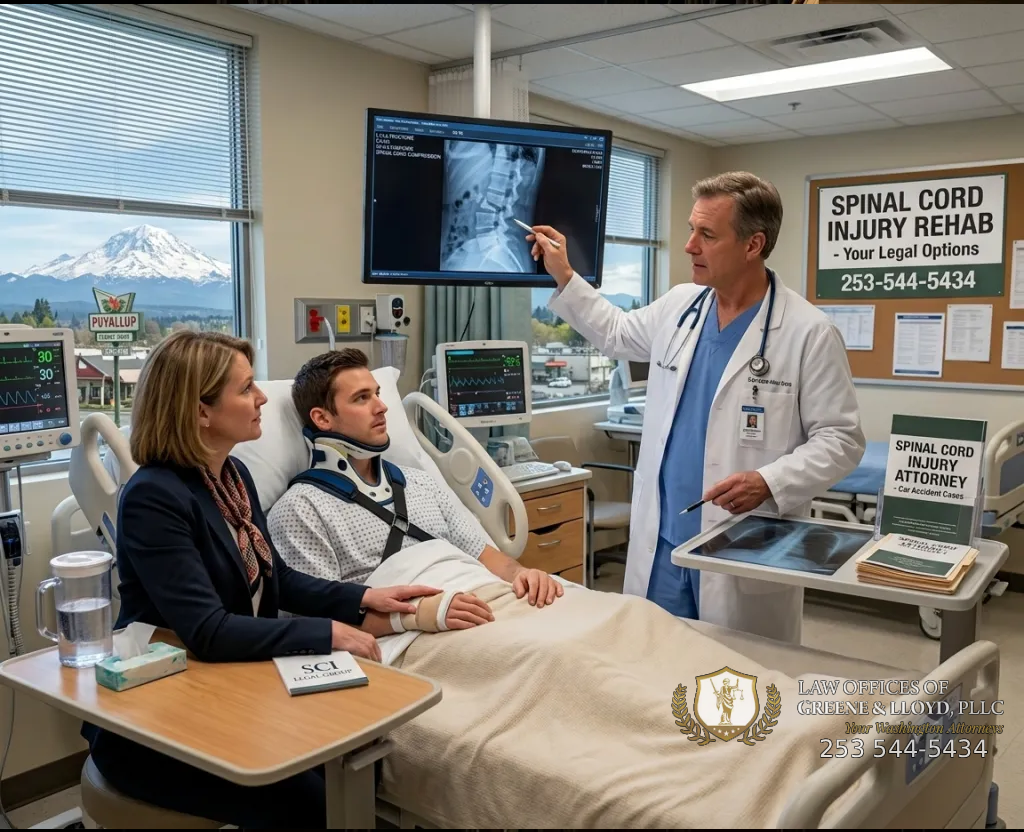
Practice Area — Spinal Cord Injury
Spinal Cord Injury Attorney
A spinal cord injury changes everything — and a claim that doesn't account for a lifetime of care, equipment, and lost capacity will leave a family permanently short of what they need. Attorneys Rob Lloyd and Tim Greene handle spinal cord injury cases with the expert support, documentation, and litigation preparation that catastrophic injury claims require. Free, confidential, available 24/7.
Serving Puyallup, South Hill & all of Pierce County · Free consultation available 24/7
No capOn non-economic damages in WashingtonSofie v. Fibreboard (1989)
3 yrsTo file in WashingtonRCW 4.16.080
No feeUnless we recover for youContingency representation
Why These Claims Are DifferentLifetime Costs Require a Different Kind of Claim
Most personal injury claims resolve around a bounded set of losses — past medical bills, a period of lost wages, and a pain-and-suffering component. A spinal cord injury claim works differently because the losses aren't bounded. They extend across a lifetime.
What a spinal cord injury claim must account for
Acute hospitalization and surgery is just the beginning. A complete claim must document lifetime medical costs — ongoing care and monitoring, future surgeries or procedures, rehabilitation, attendant care hours, adaptive equipment, home and vehicle modifications, and the management of secondary conditions that accompany spinal cord injuries. It must also account for permanent loss of earning capacity and the profound non-economic losses that no dollar figure fully captures — loss of independence, loss of the activities that defined a life, pain that continues indefinitely.
Settling a spinal cord injury claim before that full picture is documented — or accepting an early offer before life-care costs are established — can leave a family tens or hundreds of thousands of dollars short of what they'll actually need. That gap doesn't close after a release is signed.
Common CausesHow Spinal Cord Injuries Happen in Puyallup Personal Injury Cases
Spinal cord injuries in Pierce County most commonly result from:
- High-speed vehicle collisions — car, truck, and motorcycle crashes on corridors like Hwy 512, Meridian Ave, Canyon Road, and SR 167 where speed amplifies the forces transmitted to the spine in an impact.
- Truck and commercial vehicle crashes — the mass disparity between a large commercial vehicle and a passenger car produces disproportionate injury severity.
- Falls from height on construction sites, roofing work, or scaffolding — where the L&I-vs-third-party framework (RCW 51.24.030) may create both a workers' comp and a civil claim.
- Premises liability incidents — falls down stairs, from elevated surfaces, or into unguarded openings.
- Sports and recreational accidents — diving into shallow water, contact sports impacts, off-road vehicle crashes.
Each cause points to a different responsible party and a different insurance structure — vehicle insurer, commercial carrier, property owner, employer and third party, or product manufacturer. Identifying every source is one of the first things a catastrophic injury claim requires.
Washington LawNo Cap on Damages & the Filing Deadline
Washington does not cap non-economic damages
The Washington Supreme Court struck down the state's cap on non-economic damages in Sofie v. Fibreboard Corp., 112 Wn.2d 636 (1989). Pain, suffering, loss of enjoyment of life, and loss of consortium are not artificially limited — a jury can award what the evidence supports. In spinal cord injury cases, where those losses are permanent and profound, this matters more than in almost any other injury category.
Three years — but preparation time matters
Washington's general personal injury deadline is three years from the date of injury (RCW 4.16.080). A spinal cord injury claim is complex enough that preparation time is meaningful — identifying all liable parties, retaining life-care planning and vocational experts, obtaining complete medical records, and building the future-cost documentation takes months, not days. Acting early protects both the deadline and the quality of the claim.
Comparative fault still applies
Washington's pure comparative fault rule (RCW 4.22.005) means shared responsibility reduces but does not eliminate recovery. In catastrophic injury cases, fault assignment is aggressively litigated by defense insurers — having expert support for the liability case is as important as having it for the damages case.
This page provides general information about Washington law and is not legal advice. The rules and deadlines that apply depend on the specific facts of your case; contact us to discuss your situation.
Expert SupportWhy Life-Care Planning and Vocational Experts Matter
An insurer's offer on a catastrophic injury case is only as credible as the documentation behind it. Without expert support, a spinal cord injury claim is essentially unsupported — and an insurer has every incentive to minimize what they pay.
- Life-care planners develop a detailed, professionally documented projection of future medical needs and costs over the injured person's expected lifetime — adaptive equipment, attendant care hours per day, home modifications, future procedures. This is the foundation of a future-cost claim.
- Vocational experts assess the permanent impact on earning capacity — the difference between what the person could have earned over their working life and what they can earn now, if anything.
- Medical experts establish the permanence and severity of the injury, the prognosis, and the standard of care for future treatment.
We engage expert support early — because building a well-documented claim from the start is what produces a settlement or verdict that reflects the actual scope of the loss. You work directly with Rob Lloyd and Tim Greene throughout. We handle spinal cord injury claims on a contingency-fee basis — no fee upfront, a fee only if we recover for you.
Common Questions
Spinal Cord Injury Claim FAQ
How is a spinal cord injury claim different from a regular personal injury claim?
The scale and permanence. Most personal injury claims resolve around past medical bills and a period of lost wages. A spinal cord injury claim must account for lifetime medical costs — ongoing care, adaptive equipment, home modifications, attendant care, future surgeries — and the profound non-economic losses associated with permanent disability. Settling too early or for too little can leave a family permanently short of what they'll need.
What causes spinal cord injuries in Puyallup personal injury cases?
The most common causes are vehicle collisions — car, truck, and motorcycle crashes on high-speed corridors like Hwy 512 and Meridian Ave — along with falls from height on construction sites, workplace accidents, and recreational incidents. Each cause points to a different responsible party and insurance structure.
Can I recover non-economic damages for a spinal cord injury in Washington?
Yes, and Washington has no cap on non-economic damages. The Washington Supreme Court struck down the state's cap in Sofie v. Fibreboard Corp., 112 Wn.2d 636 (1989), meaning a jury can award whatever the evidence supports for pain, suffering, and loss of enjoyment of life. In spinal cord injury cases, those non-economic losses are often the largest component of the claim.
How long do I have to file a spinal cord injury claim in Washington?
Three years from the date of injury (RCW 4.16.080). However, a spinal cord injury claim is complex enough that preparation time matters — identifying all liable parties, retaining life-care planning and economic experts, and building the case for future costs all take time. Don't wait.
Will I need expert witnesses for a spinal cord injury claim?
Almost certainly for a significant claim. Life-care planners document the full scope of future medical needs and costs; vocational experts assess earning capacity loss; medical experts explain the injury's permanence and prognosis. These experts give a lifetime-cost claim credibility in front of an insurer or a jury.
How are spinal cord injury attorney fees structured?
On a contingency-fee basis. You pay no upfront attorney fee, and a fee is owed only if we recover compensation for you. Your initial consultation is free.
Talk to a Puyallup Spinal Cord Injury Attorney
A lifetime of costs requires a claim built to match.
Spinal cord injury cases require expert support, thorough documentation, and representation prepared to go to trial if needed. Greene & Lloyd is ready to help. Your case review is free, confidential, and available 24/7.
The Law Offices of Greene & Lloyd, PLLC
4115 S Meridian Ste B, Puyallup, WA 98373(253) 544-5434 · Free consultation 24/7
Serving
Puyallup · South Hill · TacomaAll of Pierce County, Washington
The information on this page is provided for general informational purposes only and does not constitute legal advice, nor does it create an attorney-client relationship. Case citations and statutory references describe general Washington law and may not reflect the specific facts or deadlines of your situation. Consult a licensed Washington attorney about your individual case. Prior results do not guarantee a similar outcome.
