
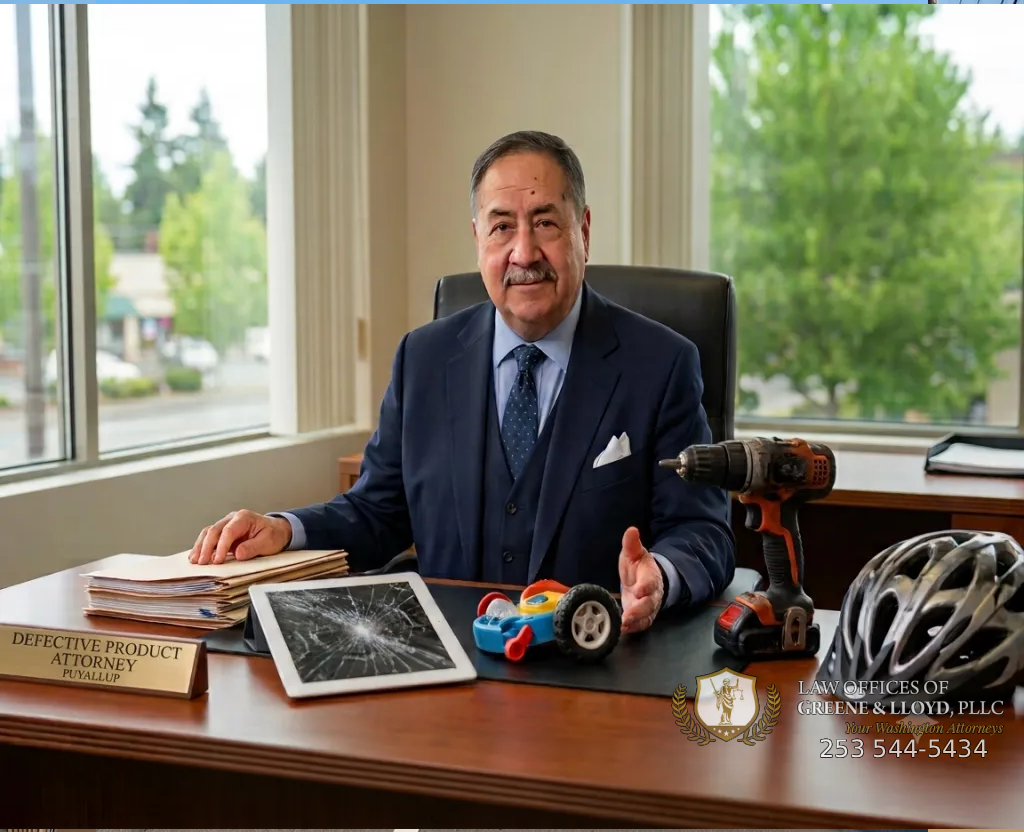
Practice Area — Product Liability
Defective Product Attorney
Injured by a defective appliance, tool, vehicle part, or consumer product? The manufacturer may be responsible — even if a warranty replacement has already been offered. Washington's Product Liability Act holds manufacturers, distributors, and retailers accountable for products that injure people. Attorneys Rob Lloyd and Tim Greene can tell you whether you have a claim and what to do next. Free, confidential, available 24/7.
Serving Puyallup, South Hill & all of Pierce County · Free consultation available 24/7
3 yrsTo file in WashingtonRCW 4.16.080
RCW 7.72Washington Product Liability ActThe controlling statute
No feeUnless we recover for youContingency representation
Three Types of DefectsWhat Qualifies as a Defective Product Under Washington Law
Washington's Product Liability Act (RCW 7.72) governs these claims — not general negligence law. It recognizes three types of product defects, each of which can support a personal injury claim:
- Design defect — the product was unreasonably dangerous as designed, even if manufactured exactly as intended. Example: a power tool whose guard can be removed too easily, or a vehicle with a roof structure prone to collapse.
- Manufacturing defect — the design was sound, but something went wrong in production, making a specific unit dangerous. Example: a batch of appliances with wiring errors, or a structural component with a hidden flaw.
- Failure to warn — the product posed a known risk that wasn't adequately disclosed in instructions or labeling. Example: a chemical product that doesn't warn of a dangerous reaction with common household items.
Liability can extend beyond just the manufacturer. Distributors and retailers in the product's chain of sale can also be held responsible under Washington law, depending on the facts of the case.
Be HonestWhen You May Not Need a Defective Product Attorney
Not every product complaint needs a lawyer, and we'll tell you so. If the dispute involves no personal injury and only a refund or replacement of property worth less than $10,000, Washington's small claims court (RCW 12.40.010) may be a faster and cheaper path than hiring counsel — and you can often resolve it directly with the manufacturer or retailer.
An attorney becomes relevant when there is a personal injury — burns, lacerations, fractures, or other physical harm — because that's where a product liability claim under RCW 7.72 provides remedies (medical costs, lost wages, pain and suffering) that a warranty replacement or small claims action can't.
Act NowProtecting Evidence Before You Call
The single most important thing you can do right now is preserve the product. The defective item itself is usually the most critical piece of evidence in a product liability case — and most people unknowingly destroy it by repairing it under warranty, returning it to the retailer, or discarding it. Once it's gone, proving the defect becomes far harder.
- Don't repair, return, or discard the product. Keep it exactly as it was after the incident, in a safe place.
- Document everything — photograph the product and your injuries immediately, before any changes.
- Get medical care promptly. Many injured Puyallup-area residents are treated at MultiCare Good Samaritan — the medical record is the foundation of a personal injury claim.
- Save all product documentation — purchase receipts, manuals, warranty paperwork, and any communications with the manufacturer or retailer.
- Check for a recall at SaferProducts.gov (CPSC). A recall combined with an injury may strengthen your claim.
Recalls and warranty repairs don't pay for your injuries
A recall notice addresses the product — a repair, replacement, or refund. It does not compensate you for medical costs, lost wages, or pain and suffering. A warranty repair or exchange is similarly separate from a personal injury claim. Accepting a replacement doesn't waive your injury claim. These are two different remedies, and you may pursue both.
Washington LawHow the Law Shapes Your Claim
The three-year filing deadline
Personal injury claims under Washington's Product Liability Act must generally be filed within three years of the date of injury (RCW 4.16.080). Missing that window can bar an otherwise valid claim entirely.
The 12-year statute of repose — and why older products still matter
Washington has a statute of repose (RCW 7.72.060) that creates a rebuttable presumption — not a hard bar — that a product is not defective if the injury occurs more than 12 years after delivery. This affects claims involving older appliances, tools, and vehicles, but it is rebuttable, meaning a strong claim may still proceed. If your injury involved an older product, this is something to discuss in a consultation rather than assume your claim is barred.
Comparative fault still applies
Washington's pure comparative fault rule (RCW 4.22.005) applies to product liability claims. Even if you were partly responsible — say, you used a product in a way the instructions didn't recommend — your recovery is reduced by your share of fault rather than eliminated.
This page provides general information about Washington law and is not legal advice. The rules and deadlines that apply depend on the specific facts of your case; contact us to discuss your situation.
The ProcessWhat to Expect From a Defective Product Claim
Once you contact us, a product liability claim typically moves through: a free case evaluation to determine whether a defect caused the injury and who is responsible, investigation and records gathering (medical records, the product's purchase and recall history, expert review if needed), identification of every liable party in the chain of distribution, negotiation with the manufacturer's or distributor's insurer, and if needed, filing suit in Pierce County Superior Court.
These cases can run months to years depending on the number of defendants, whether expert engineering testimony is needed to prove the defect, and the severity of the injury. We handle product liability claims on a contingency-fee basis — no attorney fee upfront, and a fee only if we recover for you. You work directly with Rob Lloyd and Tim Greene throughout.
Common Questions
Defective Product Claim FAQ
What qualifies as a defective product under Washington law?
Under Washington's Product Liability Act (RCW 7.72), a product is defective if it is unreasonably dangerous due to a design flaw, a manufacturing error, or a failure to warn users of known risks. All three types can support a personal injury claim if the defect caused an injury.
How long do I have to file a defective product claim in Washington?
Generally three years from the date of injury (RCW 4.16.080). Washington also has a statute of repose (RCW 7.72.060) that creates a rebuttable presumption that a product is not defective if the injury occurs more than 12 years after delivery — relevant for older appliances, tools, and vehicles. Speak with an attorney promptly.
Do I still have a case if the product was recalled?
Possibly, and the recall can actually support your case. A recall notice addresses the product itself — typically a repair, replacement, or refund — but it does not compensate you for personal injury, medical costs, or pain and suffering. A recall combined with an injury may strengthen a product liability claim.
What happens during my first visit to Greene & Lloyd's Puyallup office?
You speak directly with attorney Rob Lloyd or Tim Greene. We review how the injury happened, explain whether your situation supports a claim under Washington's Product Liability Act, discuss evidence preservation, and answer your questions — at no cost and with no obligation.
How are defective product attorneys usually paid?
On a contingency-fee basis. You pay no upfront attorney fee, and a fee is owed only if we recover compensation for you. Your initial consultation is free.
Can I still make a claim if I already repaired or returned the product?
Possibly, but it becomes harder. The product itself is often the most important piece of evidence, and returning or repairing it under a warranty exchange can make it difficult to prove the defect. If the product still exists with the original party, your attorney may be able to secure it through a legal preservation request.
Talk to a Puyallup Defective Product Attorney
Don't return the product. Call us first.
If a defective product injured you or someone in your family, preserving the evidence and understanding your options now can make all the difference. Greene & Lloyd is ready to help — your case review is free, confidential, and available 24/7.
The Law Offices of Greene & Lloyd, PLLC
4115 S Meridian Ste B, Puyallup, WA 98373(253) 544-5434 · Free consultation 24/7
Serving
Puyallup · South Hill · TacomaAll of Pierce County, Washington
The information on this page is provided for general informational purposes only and does not constitute legal advice, nor does it create an attorney-client relationship. Statutory references describe general Washington law and may not reflect the specific facts or deadlines of your situation. Consult a licensed Washington attorney about your individual case. Prior results do not guarantee a similar outcome.
