
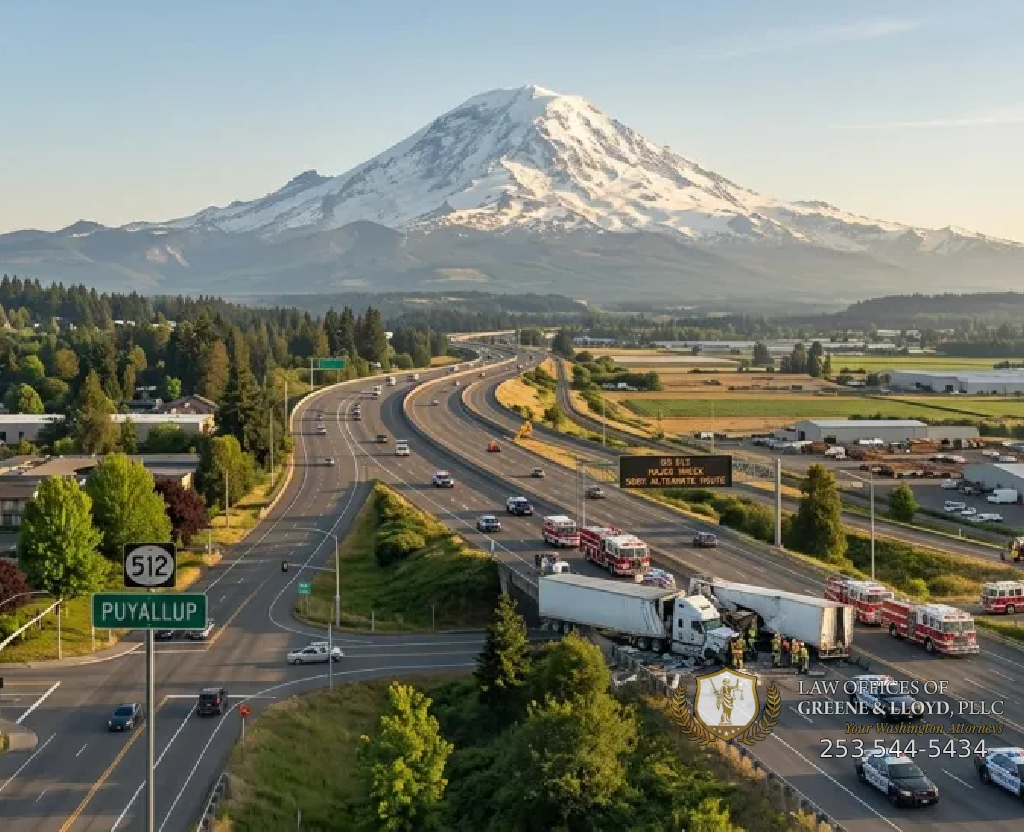
Practice Area — Truck Accidents
Truck Accident Attorney
A crash with a semi-truck isn't like a two-car accident. The carrier's insurer has a $750,000+ policy to protect, sends investigators immediately, and operates under a federal regulatory framework most people have never heard of. Attorneys Rob Lloyd and Tim Greene understand that framework — the hours-of-service rules, the ELD data, the multiple defendants — and pursue every dollar available. Free, confidential, available 24/7.
Serving Puyallup, South Hill & all of Pierce County · Free consultation available 24/7
$750KFederal minimum for large carriers49 CFR 387.9
3 yrsTo file in WashingtonRCW 4.16.080
No feeUnless we recover for youContingency representation
Why It's DifferentThree Ways Truck Accident Claims Differ From Car Crashes
A collision with a semi-truck looks like a vehicle accident at the scene. The legal claim behind it is structurally different in three important ways:
Federal regulation creates additional liability grounds
Large freight carriers operate under Federal Motor Carrier Safety Administration (FMCSA) rules — including hours-of-service limits that cap how long a driver can operate without rest (49 CFR Part 395), vehicle inspection and maintenance standards, cargo securement requirements, and driver qualification and drug testing rules. A carrier who violated any of these isn't just negligent under state law — they violated federal regulations designed specifically to prevent the crash. Those violations become independent evidence of fault.
Higher insurance means a more aggressive defense
Large motor carriers must carry a federal minimum of $750,000 in liability coverage (49 CFR 387.9) — many times the minimum required for a personal vehicle. That larger policy means a more sophisticated and aggressive insurer defense, and it's exactly why trying to negotiate a trucking claim without legal representation puts you at a significant disadvantage.
Multiple parties can be liable
Beyond the driver, a trucking crash can involve the motor carrier (for negligent hiring, training, or dispatch), a leasing company if the tractor was leased separately, a cargo loader or shipper if improper loading contributed, and a maintenance provider if a mechanical failure played a role. Identifying every liable party — and every applicable policy — is one of the first things a truck accident attorney does.
Evidence WindowWhat to Do Right After a Truck Crash in Puyallup
Truck-specific evidence has a short legal retention window. Acting fast is what preserves the records that prove the case:
- Get medical care and call the police. Many serious truck crash victims in Pierce County are treated at MultiCare Good Samaritan. A police report is essential — don't let anyone discourage you from making one.
- Record the truck's identity — the company name and markings, the USDOT number on the cab door, the license plate, and trailer numbers.
- Photograph everything — both vehicles, the scene, road conditions, skid marks, cargo spills, and your injuries.
- Get witness information — other drivers, bystanders, anyone who saw what happened.
- Don't give a recorded statement to the carrier's insurer or investigators before speaking with an attorney.
- Contact an attorney the same day if possible. ELD data, dashcam footage, and driver logs can be overwritten or legally destroyed within days — a formal preservation demand is often what saves that evidence.
Local RoadsWhere Truck Crashes Happen Around Puyallup
Puyallup sits at the intersection of several major freight corridors that carry significant commercial truck traffic:
- State Route 512 — a primary east-west connector with heavy truck traffic between I-5 and the SR 167/410 interchange.
- State Route 167 (the Valley Freeway) — a major freight route connecting the Port of Tacoma to the regional distribution network.
- Meridian Ave — the commercial spine of South Hill, with consistent delivery and service vehicle traffic.
- Canyon Road — a heavy arterial with a mix of commercial and through traffic.
- State Route 410 — connecting Puyallup to the mountain corridor with ongoing freight use.
The proximity to the Port of Tacoma means commercial truck density in the area is unusually high — a realistic backdrop for the kinds of crashes these pages address.
Driver FatigueHours-of-Service Violations and What They Mean for Your Claim
Driver fatigue is a documented factor in a significant share of large truck crashes nationally — and federal hours-of-service rules exist specifically to limit it. When a carrier pressures a driver to exceed legal driving limits, or when a driver falsifies their logs, those violations aren't just regulatory — they're evidence that the carrier knowingly created the risk.
ELD data doesn't lie — if it's preserved
Modern trucks are required to use Electronic Logging Devices (ELDs) that automatically record driving time, rest periods, and location — replacing paper logbooks that were easier to falsify. That data can confirm exactly how many hours the driver had been behind the wheel. But ELD data has a limited retention window, and carriers are not obligated to preserve it indefinitely. A formal legal hold request, sent quickly, is often the only way to secure it before it's gone.
This page provides general information about Washington and federal law and is not legal advice. The rules and deadlines that apply depend on the specific facts of your case; contact us to discuss your situation.
Washington LawComparative Fault, the Deadline & No Cap on Damages
Partial fault doesn't end your claim
Washington's pure comparative fault rule (RCW 4.22.005) applies to truck accident cases. Even if you share some responsibility, your recovery is reduced by your percentage of fault rather than eliminated. In high-value truck cases, fault assignment is aggressively contested by defense counsel — which is exactly why having an attorney who knows the trucking regulatory framework matters on both the liability and the damages side.
Washington has no cap on non-economic damages
Under Sofie v. Fibreboard Corp., 112 Wn.2d 636 (1989), Washington imposes no statutory cap on non-economic damages. In serious truck crash cases involving TBI, spinal injuries, or wrongful death, this matters significantly — a jury can award what the evidence supports for pain, suffering, and loss of enjoyment of life.
Washington's general personal injury deadline is three years from the date of the crash (RCW 4.16.080). We handle truck accident claims on a contingency-fee basis — no attorney fee upfront, a fee only if we recover for you. You work directly with Rob Lloyd and Tim Greene throughout.
Common Questions
Truck Accident Claim FAQ
What makes a truck accident claim different from a car accident claim?
Three things: federal regulation, higher insurance minimums, and more defendants. Large freight carriers must comply with FMCSA rules on driver hours, vehicle maintenance, and cargo loading. They must carry at least $750,000 in liability coverage (49 CFR 387.9). And a trucking crash may involve the driver, the motor carrier, a leasing company, a cargo loader, and a maintenance provider — all potentially liable.
What should I do immediately after a truck accident in Puyallup?
Get medical care and call police. Record the truck's DOT number, company name, and trailer numbers. Photograph the scene before anything is moved. Get witness contact information. Do not give a recorded statement to the carrier's insurer or investigators. Contact an attorney quickly — ELD data, dashcam footage, and driver logs can be overwritten within days.
How long do I have to file a truck accident claim in Washington?
Three years from the date of the crash under Washington's general personal injury statute of limitations (RCW 4.16.080). But truck-specific evidence — ELD data, black box recordings, dashcam footage, and driver qualification files — has a short legal retention window. Acting early is what preserves that evidence.
Can I still recover damages if I was partly at fault for the truck crash?
Yes. Washington follows a pure comparative fault rule (RCW 4.22.005). Your recovery is reduced by your percentage of fault rather than eliminated. In truck accident cases, fault assignment is aggressively contested — which is exactly where having an attorney who knows trucking regulations matters.
Who can be sued in a truck accident case?
Multiple parties can share liability: the truck driver, the motor carrier, a leasing company, a cargo loader or shipper, and a maintenance provider. Identifying every liable party — and every applicable policy — is one of the first things a truck accident attorney does.
What federal rules apply to truck accident cases?
The FMCSA sets the primary federal framework. Relevant rules include hours-of-service limits (49 CFR Part 395), minimum insurance requirements (49 CFR 387.9), vehicle inspection and maintenance standards, and driver qualification and drug testing requirements. Violations of these rules are important evidence in a truck accident case.
Talk to a Puyallup Truck Accident Attorney
The carrier's investigators are already working. You should be too.
Trucking companies send investigators quickly after a crash — and ELD data can be gone within days. Greene & Lloyd knows the federal framework and moves fast to preserve the evidence that proves these cases. Your case review is free, confidential, and available 24/7.
The Law Offices of Greene & Lloyd, PLLC
4115 S Meridian Ste B, Puyallup, WA 98373(253) 544-5434 · Free consultation 24/7
Serving
Puyallup · South Hill · TacomaAll of Pierce County, Washington
The information on this page is provided for general informational purposes only and does not constitute legal advice, nor does it create an attorney-client relationship. Federal regulatory references describe general FMCSA requirements and may not reflect current rules or the specific facts of your situation. Consult a licensed Washington attorney about your individual case. Prior results do not guarantee a similar outcome.
