
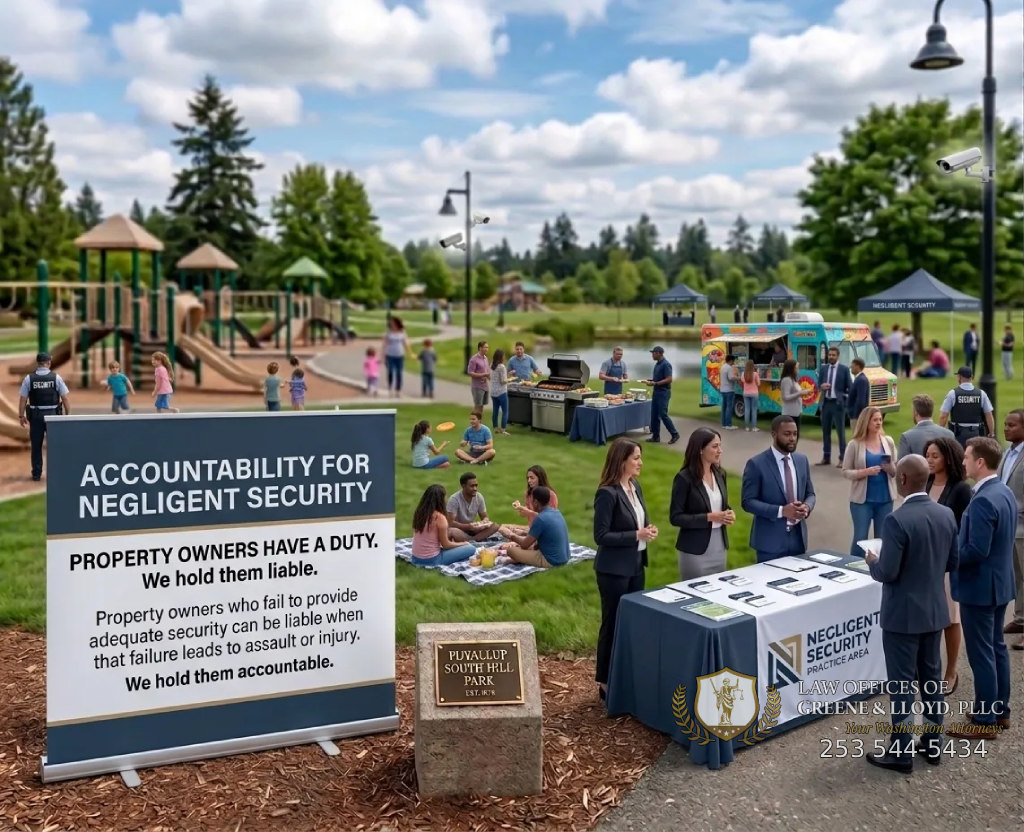
Practice Area — Negligent Security
Negligent Security Claims
If you were assaulted or injured because a property owner failed to provide adequate security, that owner may be legally responsible — even though they didn't commit the crime. Washington premises liability law holds property owners accountable when foreseeable criminal activity occurs because of inadequate lighting, broken locks, absent guards, or other security failures. Attorneys Rob Lloyd and Tim Greene represent victims of negligent security across Pierce County. Free, confidential, available 24/7.
Serving Puyallup, South Hill & all of Pierce County · Free consultation available 24/7
ForeseeableCrime is the legal standardWA premises liability
3 yrsTo file in WashingtonRCW 4.16.080
No feeUnless we recover for youContingency representation
The Legal StandardWhat Makes a Property Owner Responsible for a Crime
The central question in every negligent security case is foreseeability: did the property owner know, or should they have known, that criminal activity was a foreseeable risk at this location — and did they fail to take reasonable steps to prevent it?
Foreseeability is what the case turns on
A property owner is not an insurer against all crime. But when prior incidents, police reports, crime patterns, or the nature of the property itself give the owner reason to expect criminal activity, the law imposes a duty to take reasonable security precautions. That duty exists even though the owner didn't commit the crime — because their failure to act created the conditions that allowed it.
Evidence of foreseeability includes prior crimes at the same property, police calls for service in the area, the owner's own knowledge of security problems, inadequate or broken security measures, and the general crime environment of the surrounding neighborhood. This is why incident logs, security camera records, and property management communications are so important to gather quickly — and why they can disappear fast.
This page provides general information about Washington law and is not legal advice. Whether a viable claim exists depends on the specific facts of your situation; contact us to discuss your case.
Where It HappensCommon Settings for Negligent Security Claims in Puyallup
South Hill and the broader Puyallup area has a mix of high-density rental housing, retail centers, and large public venues — exactly the property types where negligent security claims arise most frequently:
- Apartment and rental complexes — owners and property managers owe tenants and visitors a duty to maintain safe common areas, working locks, adequate lighting in parking lots and hallways, and responsive maintenance of broken security features.
- Retail and shopping centers — parking lots and common areas at commercial properties are a frequent scene of assaults, robberies, and carjackings, particularly after dark.
- Hotels and motels — guests have a heightened expectation of security; inadequate door locks, broken exterior lighting, or unstaffed entrances can support a claim when a guest is assaulted.
- Bars and nightclubs — establishments serving alcohol have a duty to maintain reasonable crowd control and security staffing to prevent foreseeable violence on premises.
- The Washington State Fairgrounds — the annual Fair brings large crowds and creates elevated security obligations for the venue operator during the event period.
- Parking garages and lots — isolated, low-traffic environments where lighting and access control failures create foreseeable assault risk.
The ClaimWhat a Negligent Security Case Involves
A negligent security claim has three things to establish: that the property owner owed a duty of care, that the owner breached that duty through inadequate security, and that the breach caused or contributed to the criminal incident that injured you. The case is against the property owner for their failure to act — not against the criminal, though a separate civil claim against the perpetrator may also exist.
- Security failures that commonly support a claim: broken or bypassed locks, burned-out or absent exterior lighting, non-functional security cameras, no security personnel where the property's history warranted them, failure to respond to prior complaints.
- What we look for: prior incident reports at the property, police call logs for the address, property management maintenance and complaint records, security camera footage, and the physical condition of the property at the time of the incident.
Evidence disappears fast — act quickly
Security camera footage is typically overwritten within days to weeks. Incident reports can be misplaced or withheld. Locks that were broken at the time of the incident may be repaired before anyone documents them. A prompt legal hold request sent to the property owner is often the only way to preserve this evidence — and it's one of the first things we do.
Civil vs. CriminalYour Civil Claim Is Separate From Any Criminal Case
This distinction surprises many victims, and it matters practically.
- A criminal case is brought by the state against the perpetrator. You don't control it, and its outcome doesn't control your civil case.
- A civil negligent security claim is brought by you against the property owner for their failure to prevent a foreseeable crime. A criminal conviction is not required — and a criminal acquittal doesn't bar your civil claim.
- The two proceedings use different standards of proof. A civil claim requires a preponderance of the evidence — more likely than not — which is a lower bar than the criminal "beyond a reasonable doubt" standard.
In practice this means you don't have to wait for a criminal case to conclude before pursuing a civil claim, and the property owner's liability is evaluated on its own evidence independently of what happened to the perpetrator in court.
Washington LawDeadlines & Comparative Fault
Three years — but evidence won't wait that long
Washington's general personal injury deadline is three years from the date of injury (RCW 4.16.080). If a government entity owns the property — a public housing authority, a municipal facility — a notice of claim may be required first with a shorter deadline. Either way, the practical urgency is evidence preservation, which is measured in days and weeks, not years.
Being in an unsafe area doesn't bar your claim
Washington's pure comparative fault rule (RCW 4.22.005) means your recovery is reduced by your percentage of fault — not eliminated. Property owners sometimes argue the victim "put themselves in danger." That argument may reduce a recovery but does not end a claim where the property owner's security failures were a substantial cause of the injury.
We handle negligent security claims on a contingency-fee basis — no attorney fee upfront, a fee only if we recover for you. You work directly with Rob Lloyd and Tim Greene from the first consultation through resolution.
Common Questions
Negligent Security Claim FAQ
What is a negligent security claim in Washington?
A negligent security claim is a premises liability case brought when a property owner's failure to provide adequate security — working locks, lighting, fencing, or guards — allowed a foreseeable crime to occur and someone was injured. The claim is against the property owner, not the criminal, and is distinct from any criminal case against the perpetrator.
Can I sue if I was attacked in an apartment complex in Puyallup?
Possibly. An apartment complex owner owes tenants and lawful visitors a duty to maintain reasonably safe conditions, which includes adequate security in common areas. Whether a claim exists depends on whether prior crime or conditions made the attack foreseeable and whether the security measures in place were reasonable. A free consultation helps assess those facts.
How long do I have to file a negligent security claim in Washington?
Washington's general personal injury statute of limitations is three years from the date of injury (RCW 4.16.080). If a government entity owns the property, a notice of claim may be required first. Speak with an attorney promptly — security footage and incident logs can disappear quickly.
What if I was partly at fault for being in an unsafe area?
Washington follows a pure comparative fault rule (RCW 4.22.005). Being in an area that turned out to be dangerous does not automatically bar your claim. Your recovery may be reduced by your share of fault, but the property owner's failure to provide adequate security is evaluated independently.
Is a negligent security claim separate from a criminal case?
Yes. A civil negligent security claim is against the property owner for their failure to prevent a foreseeable crime — entirely separate from any criminal prosecution of the perpetrator. A criminal conviction is not required for a civil claim to succeed, and a criminal acquittal does not bar one.
How are negligent security attorney fees structured?
On a contingency-fee basis. You pay no upfront attorney fee, and a fee is owed only if we recover compensation for you. Your initial consultation is free.
Talk to a Puyallup Negligent Security Attorney
The property owner's failure to act made you a victim. Let's hold them accountable.
If you were assaulted or injured because of inadequate security at a Puyallup-area property, Greene & Lloyd is ready to help. Evidence disappears fast — your case review is free, confidential, and available 24/7.
The Law Offices of Greene & Lloyd, PLLC
4115 S Meridian Ste B, Puyallup, WA 98373(253) 544-5434 · Free consultation 24/7
Serving
Puyallup · South Hill · TacomaAll of Pierce County, Washington
The information on this page is provided for general informational purposes only and does not constitute legal advice, nor does it create an attorney-client relationship. Statutory references describe general Washington law and may not reflect the specific facts or deadlines of your situation. Consult a licensed Washington attorney about your individual case. Prior results do not guarantee a similar outcome.
